
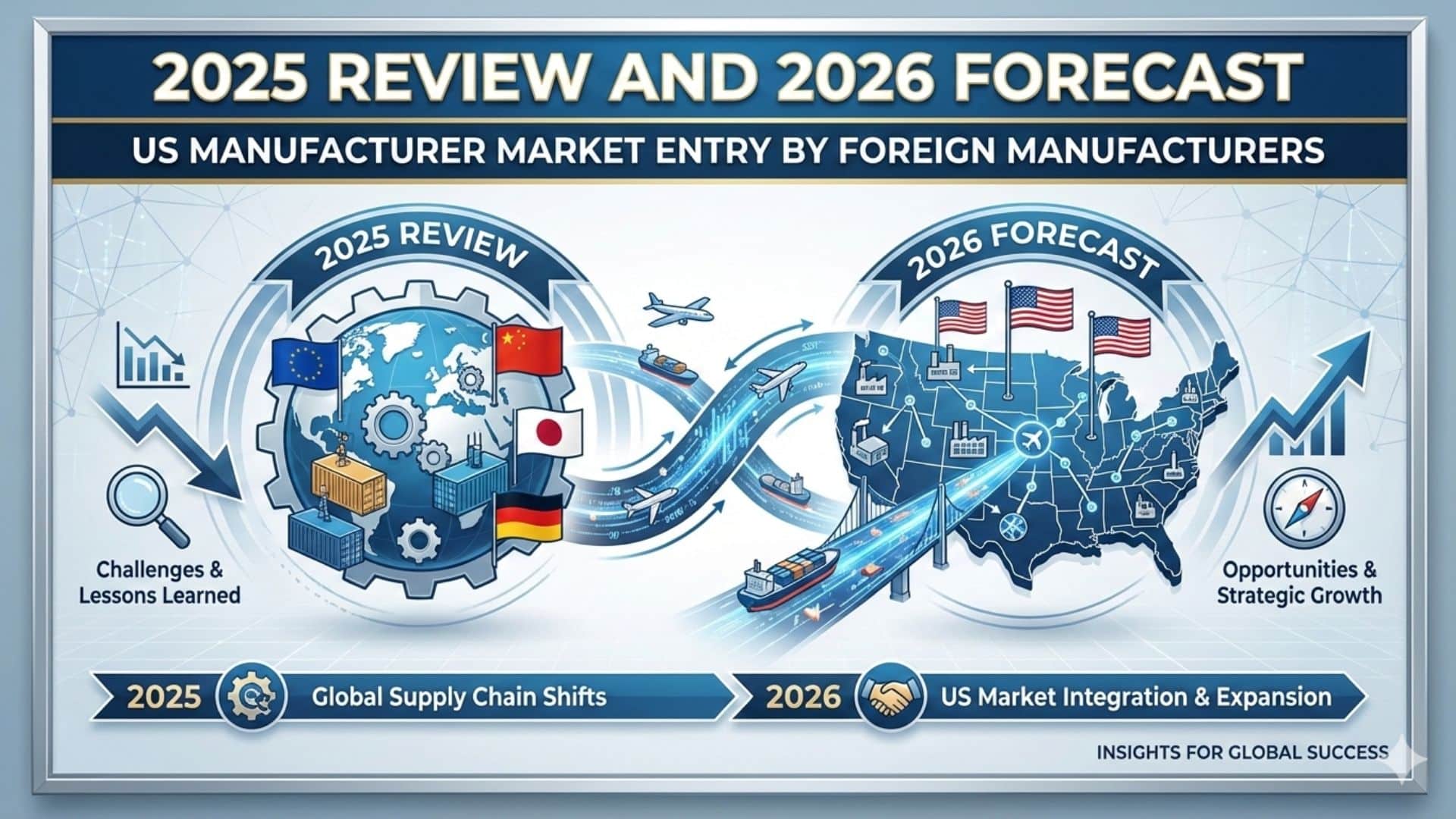
The year 2025 reshaped how foreign manufacturers think about entering and expanding in the United States, with tariffs, monetary policy shifts, cost volatility, workforce constraints, and AI adoption redefining both risk and opportunity. Looking ahead to 2026, foreign manufacturers that combine disciplined market entry, channel alignment, and pragmatic use of AI with resilient human-capital strategies will be best positioned to grow with U.S. OEMs and leading industrial distributors.
2025 in review: market entry realities
Foreign manufacturers pursuing U.S. expansion in 2025 faced a policy environment defined by renewed tariff measures and rising trade friction. New and proposed U.S. tariffs in 2025—such as additional duties on imports from China, steel and aluminum, and certain goods from Canada and Mexico—raised effective tariff rates for many manufacturing categories, increasing landed cost and compressing margins for foreign entrants. Analyses late in the year indicated these tariffs raised input costs, dampened competitiveness, and contributed meaningfully to inflation, undercutting the very manufacturing employment gains they were intended to protect.
Global monetary policy added another layer of complexity. Diverging interest-rate paths among major economies affected exchange rates and capital flows, making it harder for foreign manufacturers to model U.S. pricing and return on investment over multiyear horizons. Some U.S. importers responded by using mechanisms such as foreign trade zones and inventory frontloading to mitigate tariff and currency risk, requiring foreign suppliers to adapt production and logistics to more volatile ordering patterns.
Cost pressures and supply chain adaptation
Raw material and intermediate input costs remained volatile as tariffs intersected with lingering post pandemic supply constraints and energy price uncertainty. Studies documented that higher tariffs on key inputs such as metals and components forced manufacturers either to absorb cost increases or pass them through, eroding competitiveness in price sensitive OEM and MRO channels. This environment accelerated reshoring, nearshoring, and localized supply strategies, with many producers reevaluating sourcing footprints and dual sourcing more components closer to U.S. demand centers.
For foreign manufacturers, the practical implication in 2025 was that U.S. customers expected more resilient and responsive supply models. Industrial buyers placed greater weight on lead time reliability, inventory availability, and compliance with U.S. trade rules, rewarding partners who could redesign supply chains around regional hubs, duty mitigation programs, and flexible logistics options.
Human capital: building the U.S. goto market
Attracting, retaining, and developing U.S.-based talent became a decisive factor for foreign manufacturers trying to convert technical capability into commercial success. Tight labor markets in manufacturing and technical sales, along with tariff driven uncertainty, led many firms to delay hiring or rely on short erm fixes rather than building durable local teams. Where companies did invest, the most effective structures blended local commercial and technical talent with experienced headquarters leadership, using cross functional teams to bridge cultural, regulatory, and operational gaps between the U.S. and home markets.
Human capital strategies increasingly emphasized:
- Developing U.S. based sales engineers and key account managers who understand OEM and MRO buying processes.
- Training local teams on trade compliance, pricing under tariff and FX volatility, and value based selling versus pure cost competition.
- Creating retention plans that align incentives with long cycle channel development, rather than short term volume spikes.
AI’s impact in 2025: promise and friction
AI moved from pilot to embedded tool in manufacturing and supply chain operations through 2025, with strong uptake in quality, maintenance, and planning. Manufacturers increasingly used AI for computer vision inspection, predictive maintenance, and logistics optimization, reducing defects, unplanned downtime, and transportation costs while improving supply chain visibility. Research suggested AI enabled supply chain applications could cut logistics costs and improve service levels, which is particularly valuable when tariffs and material prices are squeezing margins.
Yet AI also introduced challenges. Industry analysis at yearend noted that many leaders overestimated how quickly AI could deliver fully autonomous operations and underestimated the effort required for data quality, governance, and workforce change management. Some organizations faced talent disruption as AI shifted skill requirements, with portions of the workforce expected to shrink in certain roles while demand increased for data literate engineers, planners, and sales teams who can use AI derived insights effectively.
Channel dynamics: OEMs and top distributors in 2025
On the demand side, OEMs and large industrial distributors ranked in leading industry “Top 50” lists continued to consolidate buying power and refine their supplier portfolios. Reports on the 2025 rankings highlight continued acquisitions, shifting positions among large industrial distributors, and more rigorous management of supplier performance, inventory, and category strategies. Many distributors with significant MRO, metalworking, and industrial supply exposure focused on expanding value added services, technical support, and integrated supply solutions, raising the bar for foreign manufacturers seeking shelf space and preferred supplier status.
For foreign entrants, 2025 underscored that success in the U.S. OEM and MRO ecosystem depends on more than competitive product cost. Manufacturers that made the most progress typically:
- Tailored product, packaging, and documentation to U.S. standards and end-user expectations.
- Invested in joint business planning with top distributors and key OEM accounts, aligning inventory, marketing, and field support.
- Demonstrated reliability under tariff and logistics disruptions, building trust in long term supply continuity.
2026 outlook: policy and cost environment
Looking into 2026, foreign manufacturers should expect continued trade policy volatility and a complex tariff landscape. Forward looking analysis projects that existing and prospective tariffs will continue to weigh on U.S. growth and manufacturing investment, with modeled reductions in U.S. growth rates extending into 2026 as trade frictions persist. Ongoing adjustments to Section 232 and other tariff programs, along with the possibility of new measures affecting major trading partners, mean that foreign producers must design U.S. entry strategies that can withstand sudden shifts in duty levels and product coverage.
At the same time, central bank policy normalization and evolving inflation dynamics will influence exchange rates and the cost of capital. Manufacturers planning U.S. investments in 2026 will need robust scenario modeling for interest rates, FX, and tariff passthrough, tying pricing, contracting, and sourcing decisions to clear risk thresholds rather than static assumptions.
Strategic cost and supply chain moves for 2026
In 2026, cost competitiveness will hinge on smart structural decisions more than on chasing short term price advantages. The reshoring and nearshoring trends that accelerated in 2025 are likely to continue, as companies seek to reduce exposure to long, tariffsensitive supply chains and align production closer to North American demand. For foreign manufacturers, practical options include:
- Establishing or partnering in regional assembly, customization, or light manufacturing operations in North America to mitigate tariffs on finished goods.
- Using duty management strategies, such as leveraging bonded facilities or foreigntradezonestyle arrangements where available through U.S. partners, to reduce effective tariff burdens.
- Designing modular product architectures that allow critical value add steps to occur in the U.S., while capitalizing on cost effective component production abroad.
Raw material and energy costs will remain sensitive to geopolitical risks and AI driven datacenter demand, which increases electricity and infrastructure requirements. Manufacturers that use AI to optimize procurement, inventory, and production scheduling can partially offset these pressures by reducing waste, improving forecast accuracy, and smoothing production runs.
Human capital in 2026: from roles to capabilities
The human capital challenge in 2026 will be less about headcount and more about capabilities. Surveys of AI and industrial leaders show that many firms expect workforce reductions in selected roles, but simultaneous increases in demand for workers who can manage advanced analytics, automation, and complex customer relationships. In the U.S. market, foreign manufacturers that stand out will:
- Build cross functional commercial teams that combine technical knowledge, channel expertise, and data literacy to act quickly on AI generated insights.
- Invest in structured onboarding and ongoing training that contextualize U.S. safety, labor, and compliance expectations for both local and expatriate staff.
- Align incentive structures with long term channel and OEM relationship development, not just annual sales volume, to reduce turnover in critical customer facing roles.
Partnerships with universities, technical schools, and industry associations can support talent pipelines in sales engineering, operations, and maintenance support—roles that remain critical even as AI and automation expand.
AI in 2026: disciplined adoption
AI in 2026 will move deeper into everyday decision making across manufacturing, logistics, and commercial operations, but value will depend on disciplined, realistic deployment. Studies indicate that AI in supply chains and industrial operations can meaningfully reduce logistics and operational costs and improve resilience by providing earlier risk signals and better coordination across functions. For foreign manufacturers entering the U.S., effective AI use will increasingly be a differentiator in conversations with OEMs and leading distributors that expect data backed performance and transparency.
However, leaders will need to confront persistent limitations. 2025 experience showed that AI delivers context and early warnings more reliably than fully automated decisions, which means organizations must keep skilled human oversight embedded in planning, pricing, and customer negotiations. The most competitive manufacturers in 2026 will:
- Use AI to anticipate demand shifts by sector and geography, aligning inventory with U.S. regional needs and key distributor locations.
- Apply predictive analytics to equipment fleets in the field, improving uptime guarantees and strengthening value propositions to OEM and MRO buyers.
- Implement governance frameworks that address data security, regulatory compliance, and ethical use, especially when sharing operational data with U.S. customers and channel partners.
Growth opportunities with OEMs and top distributors
Industrial OEM and MRO channels, including companies highlighted in Industrial Distribution’s Top 50 lists, will remain central to 2026 growth opportunities for foreign manufacturers. Market commentary on these rankings underscores continued consolidation, expansion into services, and a sharper focus on strategic supplier partnerships rather than purely transactional relationships.
To capture share in these channels in 2026, foreign manufacturers should focus on:
- Value aligned positioning: Framing offerings around total cost of ownership, reliability, and service responsiveness rather than only unit price, recognizing that top distributors and OEMs manage complex solution portfolios.
- Channel ready operations: Ensuring U.S. compliant documentation, digital product data, EDI/API connectivity, and robust forecasting capabilities that sync with distributor and OEM planning systems.
- Joint growth planning: Codeveloping market development plans with key OEM and distribution partners, including cobranded marketing, application engineering support, and coordinated inventory strategies for high growth segments such as energy transition, automation, and maintenance services.
Foreign manufacturers that combine thoughtful tariff and supply chain design, capable U.S. teams, and pragmatic AI use will be best placed to deepen relationships with OEMs and leading industrial distributors and to convert U.S. market complexity into durable competitive advantage in 2026 and beyond.
0 Comments